

Wednesday, November 01, 2006

Emmission control, greenhouse gases, global warming, climate change and human conflict.

There seems to be very little information or study dedicated to measuring the impact of human conflict, war to be precise, on climate change, global warming in particular.

Several searches on Google and other search engines render few results on the subject. Here are a few sample questions that a researcher may consider.

Producing instruments of war:
  • How much energy is consumed in the manufacture of, for instance, a Hummer, a tank, a smart bomb, an F-16, an aircraft carrier, a hand gun, a nuclear warhead? Make a list of all the instruments of war manufactured since, say 1900, as a starting point. Take the list and multiply it by the total number produced over the lifespan of the item. Add it all up and calculate the pollutants and gases produced as a result of the manufacturing process.

Using the instruments of war:

  • How much energy was required to arm the instruments of war in terms of munitions?
  • How much energy was used in getting the instruments of war to the battlefield? For instance, how much jet fuel, diesel and gasoline did it take to get the US forces to Iraq to begin with and how much has been consumed in ferrying the troops back and forth since the war began?
  • Leave Iraq aside and ask the same questions with respect to all other conflicts currently underway? How much, say, did the Israeli bombing Lebanon this year contribute to global warming?

The long term effects of war:

  • When Saddam Hussein decided to torch the oil fields at the time when the Iraqi forces retreated from their failed invasion on Kuwait the resultant fires and smoke hung like a vile smog over the planet earth, easily visible from space; do we know, or will we ever know how this impacted sustainability of life on earth?
  • Each small explosion is a pollutant; how does the grand total of all explosions since 1900 register on the climate change scale?

While the Kyoto agreement is well-meant it comes nowhere close to seriously addressing the issue of climate change. The fact that certain developed countries choose to ignore even this miniscule attempt at correcting the direction in which we are headed, is astounding. Far from being a step in the right direction, Kyoto is nothing more than a glance in the right direction.

While international aid agencies undertake a variety of missions and good work to save helpless communities in one corner of the globe or another, our leaders from every side of the political spectrum continue to fail us utterly by ignoring the larger issue which asks a simple question: do we have any interest at all in perpetuating life on earth?

Saturday, October 28, 2006

It's the stupid economy.

Friday, October 27, 2006

Note to self: needs more work.

Conflictus veritas

noun /konflikt/ 1 a serious disagreement or argument. 2 a prolonged armed struggle. 3 an incompatibility between opinions, principles, etc.: a conflict of interests.
verb /konflikt/ be incompatible or at variance with.
— DERIVATIVES conflictual adjective.
— ORIGIN Latin conflictus ‘a contest’.

Where on earth would we be without conflict?

The primary question is: would an accurate understanding of human conflict bring society any closer to the removal of conflict from the global community in the key areas of individual, territorial, sovereign, scientific and belief debates?

The secondary question is: what is the theory of conflict in as much as how does it exist in nature and is it possible to link the first occurrence of conflict in nature with the human experience of conflict?

The tertiary question is: Can the origin of conflict be traced to its first occurrence?

The tertiary question is easy to answer; the answer is ‘no.’

The secondary question would be easy to answer were it not for the suggestion that human conflict can be traced to the existence of conflict in nature. Without putting too fine a point on the question; can the existence of the universe possibly be the result of some unknown, untraceable cosmic conflict and if that should be the case, does it explain the prevalence of conflict in almost every corner of the human experience? The primary or baseline conflict, as such, is that conflict between the artificial world as devised by man and the natural world.

While some people – this author included – hold that the universe came about through a happy, chemical accident some billions of years earlier (even before of Wheel of Fortune). Then there are the newcomers who adopted the notion some two or three thousand years ago that suggesting the universe was created at the pleasure of grand architect.

Creation by design is popular among the religions today on both sides of the Christian-Muslim conflict; this point at least is one they can agree on. Creation by happenstance, on the other hand, seems to be, ironically, the scientific view; that’s at least one thing that scientists for the most part can agree on. However, what if the answer lies somewhere buried in the notion that the designer and chemistry were in conflict and that the result was the universe – a monument, in other words, to conflict.

And conflict itself, in the modern or earthly experience is the shackle that binds us all.

"The great masses of people will more easily fall victims to a big lie than to a small one. Especially if it is repeated over and over."
Adolph Hitler

While the notion that lying to the public on a daily basis may somehow influence the masses is attributed to Hitler, it would be comical to think that it was he who first came up with idea. Equally, today advisers to US presidents simply need to remind their charges of the effects of the repeated lie and hey presto a new conflict is born.

The lie appears to be conflict’s womb.

Hitler lied about the Jews, Bush lied about WMDs, the west lied when if offered aid to Africa, and the Europeans lied to the North American first nations. The list of deceptions is long and it is safe to say that the Taleban are lying to the Afghanis and certainly safe to say that al-Qaeda is lying through its cloth-covered teeth to the peoples of the mid-east.

The conflicts are enough to attest to the lies; what more evidence is needed?

Inner conflict, that old villain, waits silently ready pounce in the event that external conflict should for one brief moment take a breather. And it is at the doorstep of inner conflict that the blame so often is laid when broader conflict erupts. Not wishing to dwell on the gentleman, but it is well-accepted beyond postulation at least that Hitler’s inner conflict was soon to manifest itself in the lie that all but brought the world to its knees as the resultant conflict raged.

Whether in its most fundamental form, inner, external, personal, communal, international or galactic it would seem that conflict is of itself as natural a part of life as, say, death. Avoidance of conflict is seemingly impossible. Eradication of conflict is a stillborn concept. The question remains; what precisely is the DNA of conflict? How may it be described molecule by molecule? It cannot exist simply in our heads, figmental or imagined without biological or chemical trace.

When manifest, conflict is tangible to say the least. Our hospitals and war zones are credible witness to the tastes, smells and sounds of conflict. When gestating however where does conflict reside? Where did conflict first take root? Perhaps the question by now is irrelevant given that conflict now spreads like a cancer across the planet. I’d like to say that conflict can be simply answered by our inability to educate the vast populations who think of as uneducated – and so, uneducated choose arms before discussion leads even close to solution of one conflict or the other. But unless I am mistaken it is the educated that provide arms to the uneducated. What hope can there for peace when the disparate are fed guns to fend for their rights?

How shall this real estate eventually be divided? This one big piece of land, subdivided between its nomadic peoples. Will the poor and uneducated just disappear, unable to withstand the onslaught of the developed nations? Or should the message to the rich be that when the poor go ‘they’ll take down the wealthy with them.” The full catastrophe - as it were - ultimately succumbing to the last conflict; that conflict between compassion and indifference, between comprehension and stupefaction. The pessimist will answer most certainly this is where we are destined.

The optimist for his part will be hard pressed to keep smiling while the morgues bulge grotesquely skywards with conflict’s harsh harvest.


Wednesday, October 25, 2006

Asinine canine comment

"asinine"

1. Utterly stupid or silly: asinine behavior. 2. Of, relating to, or resembling an ass

In today's news we learn that the speaker of the house intends to reopen an investigation as to whether or not Peter McKay referred to Belinda Stronach as a dog during an altercation in the house. Well, bow-wow to that.

The news today also informs us that Mr. Gomery - tolerant soul that he is - wonders whatever happened to his multi-million dollar report on the theft by politicians, bureaucrats and advertising executives of $250 million of Canadian tax payers' money.

Personally I don't believe the species of our members matters a whit; canine, feline or insect for that matter, is of little importance.

What should be of concern is that government proceeds with some dignity and sobriety towards managing the affairs of Canada, both at home and abroad.

At home we have managed to amass a $6 billion surplus which comes as no surprise as hoarding seems to be common to all factions of our political spectrum. This may be a good thing, assuming that the global economy for one reason or the other not always be as rosy as it appears to be right now; and that a rainy day may occur at any given moment. Given Canada's attitude towards to Kyoto and Climate Change, that rainy day may indeed be welcomed by all Canadians.

Abroad, of course, is where much of the $6 billion may eventually be spent as the Conservative Government acts out its fantasies in Afghanistan. The fact that our ferry's are falling apart in New Foundland, the homeless wander the streets in ever-growing numbers, the land beneath us receives less and less water, while the land above continues to suffer from urbanization, the fields are shrinking, youth become dim-witted with illicit drugs and blank stares of bureaucrats grow more blank with each question, does not bode well for us at all.

Belinda may bitch about being called a dog, so be it. The fact is that the electorate have to keep government focussed on managing our affairs. There are are several ways of doing this of course and the Conservatives seem for the moment to be sailing pretty close to the wind and as such run the risk of putting themselves to an early test in unchartered waters.

Tuesday, October 24, 2006

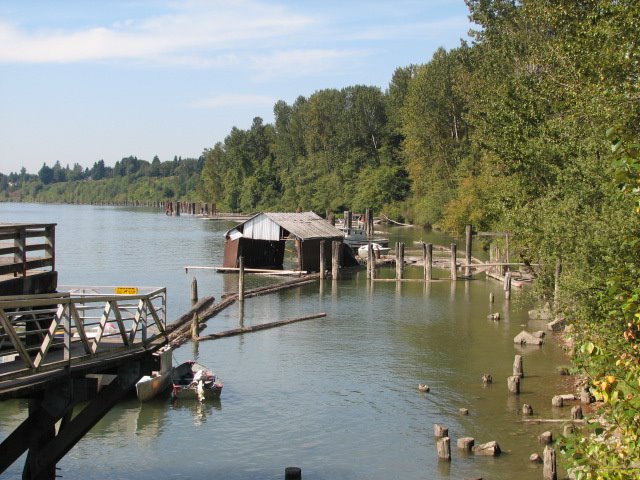
Port Haney is still witness to shipping of all sorts


Some 40 miles east up the Fraser River from the Pacific Ocean, Port Haney still sees a wide variety of ships of all sizes passing through.

They say that one day container ships carrying 'short sea containers' will be common place as the government aims to decrease road volume by increasing commercial transport on our rivers and rail networks.

Community youth fight meth addiction

Claus AndrupWhat do you know about meth addiction?

The majority of families in Pitt Meadows and Maple Ridge will never have to deal with the tragedy of addiction to crystal meth in their lives. For most of us crystal meth is something we read about in the press, see glimpses of on TV in documentaries or advertisements, or are reminded of each time we drive along East Hastings on our way back from a hockey game or concert downtown.

Politicians discuss crystal meth addiction, much in the same way that they discuss health, education or the environment. We expect them to do so and they never disappoint. As is often the case however, it takes the community itself to make the transition from ‘discussion’ to ‘action.’

Through a chance meeting between my wife Deborah and an acquaintance, Rani Bellwood, I came to find myself sitting among 50 or so young people in the Youth Lounge at Pitt Meadows recreational centre on a recent Saturday evening. Rani had suggested to my wife that we may want to attend an educational evening for youth. The theme for the evening was “Life or Meth.”

I thought that 50 or 60 children was a great turnout. They had many questions on the subject of meth and meth addiction, and were keen to share what knowledge they had gleaned informally and, perhaps more importantly, seemed eager to expand their knowledge.

The Life or Meth presentation combined videos and slides with the acting-out of two young simulated addicts who told their stories based on the lives of real characters with whom they had been in contact with or directly from RCMP or VPD reports.

Most of us are familiar with the fact that crystal meth is highly addictive and almost impossible to shake. We know too that it attacks its victim physically and mentally with severe consequences and that death is a common outcome.

Perhaps the cruelest thing about crystal meth is that once introduced to the system it immediately robs the user of his or her reason. The challenge for outreach workers and youth coordinators, it seemed to me, was how on earth do they make addicts understand in the first instance that they have a problem and second, that if they do not kick the habit, they may find themselves in the morgue?

To combat such a powerful drug takes resolve, persistence, ingenuity and the involvement of the entire community from every walk of life. In Maple Ridge and Pitt Meadows this seems to be taking place, as demonstrated by people such as Rani Bellwood chairperson of the Life or Meth Youth Forum Organization Committee, Tony Cotroneo Youth Services Coordinator for Pitt Meadows and Maple Ridge, Mary Robson chairperson Maple Crystal Meth Task Force, Andrew Tolchard Chairperson for the Pitt Meadows Crystal Meth Task Force and the community partners that assisted.


As parents and adults our views of the addicted vary. Some of us may lump together, or associate a number of unpleasant aspects of the state of our communities. Homelessness, crime, addiction, production and distribution of drugs, prostitution and child neglect become, as it were, a single issue which we think of now and then, but choose to ignore if we possibly can. Until, of course, the day that the problem walks in our own front door in the form of one of our own children.

Parent blame has always been central to any discussion where teen behaviour is concerned. What causes certain behaviour patterns in our youth? Given that our children are subjected to having to watch mum and dad’s behaviour on a daily basis and having to listen to what mum and dad have to say about this issue or that, it is hard to absolve parents from the absolute responsibility of how children respond during the long and often arduous process of becoming adults.

Parents, for their part, are not born experts and most of their training can be said to be of the ‘on the job’ variety.

That said, the least one can expect from parents is curiosity. Bringing up our children should involve a lot of who, where, why, what and when?

In the case of drug addiction among youth the call for who, where, why and when becomes even stronger as the answers to the questions can save lives and whole family structures; and ultimately whole communities.

Here are three basic questions that parents in Maple Ridge and Pitt Meadows should be asking themselves.

  • What are the chances my child will be exposed to this, and will try it
  • If my kid is using it, how to I detect that?
  • If I think my kid is using, what can I do about that?


The hackles will rise on any parent at the suggestion even that a child of theirs could become a drug addict. Oddly, today it is the youth themselves, at least in this community, who seem to be asking more questions than the parents. This bodes well for future generations and for the quality of life we can expect many decades down the road.


The probability: General population surveys on alcohol and other drug use are often done by telephone interviews. You may have even participated in surveys done through questionnaires at your school. These studies show a low rate of Meth use in the general population.


For example, a major recent survey, the Canadian Addictions Survey 2004 (CAS), asked people about their use of "speed", an informal term that covers all amphetamines, including Meth. The CAS showed that 0.8% of Canadians reported using speed at least once in the previous 12 months.


That doesn't seem like a big percentage so why the big deal?
First, 0.8% of Canadians 15 years and older equals about two hundred thousand people so, while that number is much smaller than some other substances, it's still significant. Also, standard surveys and interviews in the general population likely miss hard-to-reach people such as street youth. Information from other sources suggests that Meth use is much higher among this group.
Information, such as hospital admissions, shows that the number of people seeking treatment for Meth problems is growing. Police have also uncovered more clandestine laboratories producing Meth. They have also seized greater quantities of Meth. All these factors point to increasing Meth use, particularly in British Columbia, Alberta, Ontario and Quebec.[1]


The signs: User Denial, Family Member Denial, Enabling, Codependency, Personality changes, Immaturity (avoiding responsibility) Self-Esteem, Suicide attempts, Changes in Relationships, Lack of Motivation, Changes in Thinking, Concentration & Memory, Values and Beliefs, Denial & Lying, Changes in Sleeping and Eating patterns, Reckless & Impulsive behavior, Changes in Physical Appearance and Health, Changes in Personal Habits and Activities, Mental and Behavioral Changes, Arising Legal Problems.[2]


Action: In today’s world help is everywhere, thanks largely to the ubiquity of the internet. Each community recognizes the threat of meth addiction among youth. In Maple Ridge and Pitt Meadows we are fortunate to have among us the leadership and volunteers who understand the need to come to the assistance of victims of the proponents of illicit substances.


People such as Rani Bellwood, Tony Cotroneo, Mary Robson chairperson Maple Crystal Meth Task Force, Andrew Tolchard and a small army of youth community partners are poised to help and guide any parent in need of advice. The irony should not be lost here; in large part our volunteer youth are standing by to help parents who do not know how to react to the addictions that may be affecting their own kids. Youth helping adults – perfect.

Maple Ridge, October 2006


www.crystalmethtaskforce.com


[1] http://www.crystalrecovery.com/Recovery/Recovery.html
[2] http://www.drugwise-droguesoisfute.hc-sc.gc.ca/facts-faits/meth_e.asp#e

Sunday, October 22, 2006

'ullo, 'ullo, 'ullo!


"Say 'ullo to ma li'l fren."

Saturday, October 21, 2006

The Partioning Option

Poland, Israel/Palestine, South Africa and its Bantustans, Pakistan, India, even the UK with its English, Welsh, Scottish and Irish partitions. Closer to home the partitioning of Quebec from English Canada and what of the great unseen partition between Canada's first Nations and its pasty newcomers? What of the Balkans? Tibet? Kurdistan?

The word partition shares letters with another infamous word; apartheid. Whatever happened to tolerance and the inclusive aspirations one reads so much of in the good books of the religious. Are we not as a race, in theory at least, supposed to embrace one another, notwithstanding belief, colour, gender or culture?

When we harm one another where is the inclusiveness? How do we embrace when we embrace in death and hurt?

It is with morbid interest that we witness now the sudden notion that perhaps only a partitioning of Iraq will result in a lasting peace or at the very least a lasting, but peaceful, mutual fear. Is this the democracy that architects of the invasion of Iraq had in mind? Did they sit down and say: First we will invade because we fear that Saddam Hussein will destroy millions with his WMDs, then we'll just say that we came to save the Iraqi nation from Saddam, then we'll say they could with a good dose of western democracy and become of the American dream, then if that don't work, hell, we'll just partition the suckers to save 'em from themselves. 800,000 dead Iraqis, 5000 US servicemen and counting, a bill for one thousand billion US dollars (and counting), a confused and sickened US public. For what, the next thing that pops into the Whitehouse's mind?


What brilliant idea, one wonders, will follow the proposal for partitioning Shia, from Sunni from Kurd? Perhaps they can all join the boy scouts and sit around camp fires singing "Hail to the Chief - the idiot"? Donald Rumsfeld, I have very little doubt, will bring the marshmallows to roast over the open fires.

Friday, October 20, 2006

Iraq pullout imminent?

October 20th 2006...a drift towards stability?
Where are we today? While there is no shortage of hot spots internationally, with Iraq, the middle east, Iran, Korea and Darfur holding centre stage, it seems in a way that a general exhaustion has found its way into the hearts, minds, souls and bodies of the enemy on both sides of lines.
Perhaps one should say on both sides of all the lines, as there seem to be almost more categories of conflict which embrace so many conflicting views that making an inventory of conflict is almost impossible.
This day, this October 20th 2006, is witness to the fact that certain leaders in the US administration are leaning towards the realization that efforts to bring democracy - at least the US definition of democracy - to the middle east may soon end in the withdrawal of US troops from Iraq.
The degree to which this realization is voiced has to tempered with the fact that congressional elections are but weeks away; and what is said may be more reflection of political aspiration than true belief. For the moment at least it would seem that an inclination towards withdrawal from this costly war will garner more votes than the hawkish stance which saw Republicans steering the US for two consecutive terms.
Notwithstanding the might of the US on the world stage and the influence of the US voter on Congress and its eventual composition, there are others who carry weight as much, and combined, even more, than the US.
In Britain one TV commentator from a military college notes that today the British Army is regarded as no more than another 'tribe' fighting for its patch in southern Iraq.
Iran, a long time foe of Iraq, is viewed today with more concern by the Iraqis than they view the US.
The ground that once changed so swiftly below the feet of the coalition forces seems now it self to have morphed into quicksand.
Far away, in North Korea, Kim Jong Il declared today that one nuclear test is enough. Perhaps the realization that he could not, if push came to button push, resist a combined spanking from China, Japan, South Korea and Russia, caused him to pause in his quest for 15 seconds of fame? Perhaps, the simple threat of having his Paris Hilton lifestyle eroded by sanctions on luxury goods was enough to bring him to his senses, such as they may be.
As for "Ferme Le Bush"? One can detect, as everyone can, a toning down of the mission accomplished rhetoric.
Next time, when they 'come to the table' at the UN, don't be surprised if it is under circumstances somewhat different to what we have seen these five years past. And be very surprised if a few chairs have not been added to accommodate some new faces.

Thursday, October 19, 2006

Tolstoy made me think of this

I happened to pick up a copy of one of Tolstoy's little note books a few minutes ago. I can't even remember any particular lines that I may have scanned. Then I reflected on today's subtle - perhaps not so subtle - changes in the tone coming from the Whitehouse. There seems too a softening, though hardly detectable, in Palestine and and Kabul too. Are these the first actual steps towards some semblance of peace? Has everyone, simply, had enough?

Then some minutes later it struck me that: men of peace are sometimes made to feel awkward and even silly when it is the men of war who are the final arbiters peace and coexistence.

October 19, 2006
A birthday for peace

AfriCanada?

AfriCanada? The signs are already there

Throughout history Africa and Canada cannot be said to have had strong connections. Nonetheless, the continent of
Africa has from time to time been on Canada’s radar and once in a while the opposite has been true; there have been moments when Africa has needed Canada if for nothing else than temporary refuge. Travel back far enough in time and the researcher will find that at one point Canada even went to bat for the old Empire against the Boers during the Boer War.

Some months earlier I wrote a short piece in my blog, RadioHaney, pointing out that between them Canada and Africa formed a formidable force as a ‘resource cartel.’ Here again, history will point to the fact that for decades the relationship between South African and Canadian companies, organizations, individuals, investors and professional has grown stronger and stronger. The fact that many South Africans chose Canada as their home both during the apartheid era and in the decade plus since the fall of apartheid, has done much to enhance the relationship between the two countries and indeed, as such, the general relationship between Africa and Canada.

It could be said that hardly two less compatible or similar relationships exist in the foreign affairs arena. Canada and Africa are not only geographically distant, but remain distant in almost every aspect from climate to government to national mores and characteristics. Despite these differences however, a distinctly tangible bond can be discerned through reports in the media and via anecdotal evidence.

Much to my surprise I learnt recently that a friend of mine working at a state-owned iron ore terminal on the west coast of the Cape receives his monthly cheque from a company based in Mississauga, Ontario. The question arises, how many more opportunities exist for Canada to be the outsourcing host of choice for the South African government and large South African multi-nationals? And what, if any, trade offs lie hidden in this burgeoning relationship?

Vancouver Sun columnist Jonathan Manthorpe, in his October 19, 2006 story: For many, retirement is too good for Mugabe, quotes Zimbabwean lawyer Gabriel Shumba as saying: “We believe Canada has some of the most progressive pieces of legislation in international law on human rights,” and: “We would like to see Canada utilize some of its own laws against Mugabe because we believe jurisdiction of legislation is not limited to criminals or victims who are Canadian citizens.” These statements by Mr. Shumba, while specifically aimed at the catastrophic rule of Robert Mugabe, nonetheless go some way to highlighting yet another area of governance and economics that exist for collaboration between certain – perhaps all – African countries and Canada.

The notion of strengthening alliances between Canada and Africa falls outside of the parameters of party politics; it is not a Conservative, Liberal, NDP or Bloc-driven issue. It should be apparent to Canadians that as arbiters of responsible civic management and as good fiscal managers there exists obvious and tangible benefits in a symbiotic relationship between these distant places. Is there, for instance, any reason why Canadian manufacturers should not be enticed by large and hopeful workforces in Africa in a trade off of labour for technology, or production for management?

The September 28, 2005 piece follows for reference below:


South Africa and Canada can be resourceful partners

Growing up and being schooled in South Africa in the 1950s and 1960s resulted in a keen awareness of the fact that the country we lived in was a key player in the world's supply of many natural resources. Gold, diamonds, coal, uranium and iron to name a few. Writ large across the country's history were the names of Cecil John Rhodes, Barney Barnato and in more recent times such royal families of mineral exploration as the Oppenheimers.

From the start the scramble for mineral fortunes was reflected by both the obvious benefits to the individual adventurers from Europe and the pain and indignity forced upon the indigenous peoples of this newly occupied region. That is all behind us now. The resources themselves however remain in abundance.


Canada, while successfuly hiding the negative impact of the British and the French adventurers in the form of early trappers and later the Hudson Bay Company, is the home of an equally rich reserve of resources, almost matching if not beating South Africa in terms of natural wealth. As a team on the international resource stage, the combination of these two nations presents a formidable partnership.

Such an alliance would be built not simply on the resources themselves, but on the knowledge, skills and experience that has developed through the channels of the corporate and academic organizations in both countries. Relative economic stability, threatened only by the Boer War, two world wars and in the case of South Africa, the troubled era of Apartheid, has meant that these two countries have been able to advance their technologies at a faster pace than most other sovereignties with the exception perhaps of the United States. Russia and China while promising greater natural wealth remain less capable of mineral exploration and exploitation and politically less stable.

Today South Africa's interest rates, while still high, are coming closer in line with their peer countries such as Canada, consequently opening the doors to smoother future cooperation.


As early as the late 1970s South African entrepreneurs saw the potential for Canada as a shelter from, it seemed, South Africa's uncertain future. Interestingly too was the arrival in Canada of white Rhodesians who felt even more threatened in Africa than their kinsfolk in South Africa. The Rhodesians, it turns out, had more to fear than the South Africans.

By the time the 1990s rolled around and even more so in this new century, the presence of South African resource specialists and the companies who employ them has grown dramatically in Canada. It seems that the foundations for a strong partnership has already been laid. Curiously, there is little or no evidence of any concious political drive to initiate, support or promote this partnership. Canadian politicians are as much to blame as their South African counterparts.

The two countries could probably benefit from snuggling up closer to one another than they they have so far. South Africa and Canada have much to offer one another. Science, technology, communications, humanities, housing, social services, commerce and trade, political and corporate governance, medicine, transport, international trade, sustainable growth, urban development, aerospace, arts and culture.


Canada has helped South Africa in two strangely oriented, perhaps opposing ways. Canada has historically voiced its public opposition to the Apartheid system in the United Nations (while, it must be said, supporting its own equivalent apartheid-lile policies with respect to Canada's indigenous peoples) and on the other side of the equation Canada has welcomed many white South African immigrants who fled the uncertainties of South Africa in the 1980s and 1990s. This migration, while driven intitially by fear, may now prove beneficial to both countries.

Given the ambiguities of NAFTA and the inward-looking policies of Washington and Congress, combined with a less than welcome US attitude towards the United nations, it seems to this observer that the time for South Africa and Canada to form stronger trade and political ties is upon us. Combine these two remnants of the Commonwealth and then add in the presence of a powerful Europe and the future, to this observer a least, seems a lot brighter.

Wednesday, September 28, 2005

Wednesday, October 18, 2006

Early signs of split in homosapiens

The BBC reports today that humanity is headed towards an eventual split in the species.

Human species 'may split in two'

"Humanity may split into an elite and an underclass," says Dr Curry. "Humanity may split into two sub-species in 100,000 years' time as predicted by HG Wells."


If there is any doubt to this notion Radio Haney directs its reader(s) to Congress where early signs of the split can be detected almost daily.

" Evolutionary theorist Oliver Curry of the London School of Economics expects a genetic upper class and a dim-witted underclass to emerge. " Radio Haney further notes that the dim-witted underclass may soon loose a singnificant number of seats in Congress to be by replaced by a genetic upperclass once typified by the Kennedy family.

For the full story go to: http://news.bbc.co.uk/2/hi/uk_news/6057734.stm


Saturday, October 14, 2006

Hasta la vista, baby Kim.


AIRTIME FOR TYRANTS IS NOT WORKING

Once again our international leadership is sucked in by the dramatics of the clownish behaviour of an idiot trying to gain attention on the world stage – no disrespect intended towards professional working clowns who provide the laughter needed to distract us from the appalling ineptitude of the United Nations.

This guy is just getting too much airtime, and lovin’ it. Once in a while a bad egg will show up, posing a real threat to his region or perhaps even the world at large. The fellow shown here is not in this class. While recognized as a mean bastard of a leader by his people and observers abroad, it is foolish and indicative of a certain lack of sophistication that the Security Council is lathered up over this chap.

One can see clearly the road ahead. Discussion among the members, suggestions, threats, a vote, another toothless resolution, more debate, more resolutions followed by disagreement over the same things we disagreed over before; the chief among them being sanctions versus action.

What irritates perhaps more than anything else is that history itself points to so many instances where nations have risen in protest against regimes and leaders who have conducted themselves in somewhat less than humane ways. The Pan-Africanist movement in South Africa successfully overcame the apartheid regime, notwithstanding that some sanctions were indeed implemented by the world community. For that matter many nations throughout Africa held true to the Harold Macmillan forecast in his ‘winds of change’ speech delivered in the 1950s to a then disbelieving white leadership in Southern Africa. Most of Africa is now free of the European Kim Jong Ils of an earlier age. Asian nations have spent thousand’s of years in similar turmoil, constantly changing from school of political thought to another, either through force or by choice.

Is it perhaps not time that the people of North Korea rose up and dumped this fellow? There are many, many people prepared to lend a hand in the exercise. But the drive has to come from within North Korea, not from within the inner sanctum of the Security Council. For the better part the Security Council is more concerned with the security of their jobs. Little Kim, but acting out the role of nuclear nut has done little to create a real threat and a lot to creating jobs for life for those lucky enough work for the United Nations.

While the United States impresses us with its ability to measure radio activity in the air above North Korea who is busy measuring or forecasting the affected areas of ‘egg on our faces’ in a few years when it comes to pass that Kim Il Jong does not have two beans to rub together, let alone two atoms. This one has Hans Blix written large all over it. One might recall this quote from the BBC: “Speaking to the BBC's World Service, Mr. Blix said he was more certain than ever that there was no WMD in Iraq.” I wonder if Blix is still on the contact list on the new Secretary General’s Blackberry. He may be well advised to give Hans a call.

Who can fail to remember the hundreds of thousands of hours we helped the media with when it came to being intrigued by the life and times of Saddam Hussein. Well, from the people who brought you Osama and Saddam, watch out, because here comes Kim “it’s an IL nuclear wind that blows no good” Jong.

Sanctions are too expensive and time consuming. If Kim wants to play with the N-gang then the best solution, by far the cheapest and perhaps less costly a (in the collateral sense) is to drop one right on top Kim and end the discussion right there. The bush assault on Iraq has cost some 700,000 lives and 500 + billion dollars. From every aspect, including humanitarian, a nuclear answer to a nuclear threat would seem to the elegant solution in this instance. Shareholders of CNN may not wish to hear this as while it may be a big story it would also be a short story and we would soon be back to fighting terror and protecting borders once more, but it is hard to please everyone.

Forget pandering to Kim Jong Il's need for 15 seconds of fame; give him one split second, from one split atom and let’s move on.

Good God!

Existence may just be in the eye of the beholder

At the top of the "been there done that" list has to be the dullest debate of all; does God exist. Recent publications against the notion of God's existence are prompted no doubt more by the thrusts and parrys of the religious right (why they are presumed right is beyond comprehension) and the hysterical behaviour of the Jihadists. Throw in a smaterring of several other wannabe praisers of the cosmic designer and "voila" debate is born.

To some extent I envy the believers as the question itself never crosses their minds. Or if it does, they are unlikely to share their doubts with the rest of us.

On the other hand the non-believers too are to be envied; going about their lives, with nary a care in the world, in the full knowledge that no matter how naughty they are, or how mean-spirited their behaviour, they will never have to go to hell for their sins.

Where then does that leave the rest of us?

After some 57 years wandering about this odd little planet with its eccentric population and unpredictable weather - not to mention its argumentative tribes - it struck me that perhaps we are asking the wrong question. Wrong because any question that has no answer cannot be a good thing. For start it is bound to lead to an awful amount of time wasting. Imagine for a minute how much more mankind would have achieved by now had he not engaged in asking himself, and indeed attempting to answer, questions to which he well knows cannot be answered. Far wiser then to stick to the simple stuff like: what is matter? define gravity? where do black holes come from? how can I cure aids and cancer? what must I do to feed the world's poor? why is it getting so hot? who will be the next celebrity to adopt an African country?

So the question that we should be asking which may be easier to answer and within our comprehensive capabilities should be more along the lines of: If God exists at all, would it make one iota of difference to our lot here in earth? God or no God I dare say it life is what it is and we should not go worrying our silly little heads over stuff which is way beyond us - excluding Republicans, Conservatives and Osama Bin Laden of course, who have declared themselves way smarter than us.

Thursday, October 12, 2006

Clicheland

"Hullo, road"
"Oh, hi rubber."

Wednesday, October 11, 2006

Bring it on!

Quote from internet report today: "The region is brimming with tension following the nuclear test with North Korea accusing South Korea and Japan of "gearing up for war". Speaking on South Korea's Yonhap news agency, an unnamed North Korean official said that if the UN imposes sanctions on his country they it would be seen as a declaration of war. "Sanctions are nonsense. If full-scale sanctions take place, we will regard it as a declaration of war. The more they press us, the stronger our response will be", he was quoted as telling."

Imagine the response from the Whitehouse:-

George W. Bush: "Probably not a bad idea to get this over with quick........if you know what I mean."

Monday, October 09, 2006

China should annex N Korea

Do we really have time for this? With so many other serious issues on the table a simple UN-sanctioned invasion of North Korea by China and a handful of neighbours would be helpful to the people of North Korea who, perhaps in the words Dick Cheney would welcome China as liberators.

No, I'm not happy to see you, that's just the tongue in my cheek.

Saturday, October 07, 2006

Planet Blog

In the end they all became bloggers. The streets were empty. Life ceased. They expired in front of their monitors.Nothing.

Friday, October 06, 2006

Adapt or die - letter to the editor of the Vancouver Sun

Re: Environmental debate clouded by confusion and political timidity, October 6, 2006:
My first thought on spotting the headline of Barbara Yaffe’s piece on the report issued by Johanne Gelinas and the subsequent Commons environment committee was Ms Yafffe may have included in her report a reference to the Green Party of Canada. By the time I reached the end of the article it became clear that I would have to slap myself around the ears for being so naïve.

The environment, it seems to me, is nothing more than a sideshow when it comes to the core values of the Conservatives, the Liberals and the NDP. The long term prospects for seeing a majority Green Party of Canada sitting in Ottawa is perhaps unimaginable, perhaps even a joke to many. What is neither unimaginable, nor a joke, is that without real solutions being provided by Canada’s leadership our long-term prospects for survival on this earth are slim to none.

In the forthcoming election I would urge the Green Party of Canada to apply more pressure to the electorate and I would ask that the electorate pay closer attention to underlying message of the Green Party of Canada: adapt or die.

Claus Andrup
Maple Ridge


October 5, 2006

Friday, September 29, 2006

British Columbia in denial over healthcare

British Columbia in denial over healthcare

The media in BC have made it known that the provincial government is about to spend $10 million on a public forum which is aimed at engaging public participation in the debate on health care and its cost to the community. In her most recent budget speech the minister for finance suggested that healthcare in the near future threatens to absorb most of the province’s budget. One can assume that her speech and the recent proposal for public debate are somehow linked. How are we, the public, to interpret the message we being sent by the provincial government? What is the question we are being asked? Is this more than a $10 million discussion to demonstrate publicly that the government is at work, hoping to find solutions to a spending problem? Or is this a sincere $10 million question, the answer to which will solve the approaching threat of unmanageable healthcare costs?

Criticism of the healthcare system in British Columbia abounds, as does criticism of the medical profession and of the unions responsible for workers in healthcare. Equally, there is no shortage of resentment and severe criticism of the large, mostly global producers, of over the counter and prescription drugs. The system, the practitioners, workers and unions then may be seen as largely argumentative and disagreeable conspiracy of ‘me first’ players all vying for the upper ground in what is generally known as the healthcare system. Upper ground, in this case, is not a reference to morals, but rather a reference to financial gain. The system will argue that in order to maintain effective levels of service it needs specific funds. The practitioners with their reputation for bleeding the system will not disappoint when it comes to arguing their importance to the system, and not to be outdone, the unions will argue as pointedly as the practitioners that they are far from occupying the upper ground when it comes to compensation for their role in caring for the ill and the injured in British Columbia. As the demands for a ‘fair share’ of the medical pie grow so do the pressures on the public purse. Ironically, the public is the singular source for these funds. I attended a local BBQ this summer where Gordon Campbell quipped that there is only one kind of money and that was ‘your money, the public.’ We all agree on that view, no matter what our political background or beliefs. One would think, naively perhaps, that as it is our money we ought to have some say in how it is spent. That being the case, the proposed forum on healthcare in British Columbia is perhaps not as off-the-wall as one may think on first hearing about it.

The public, however, seem to forget that as individuals they are solely responsible for the escalating costs of health here in this province and indeed in many other provinces and countries in the developed world. The public, the practitioners (public and private), the healthcare systems, the unions and their members, the care facilities boards and management, drug and equipment manufacturers come together to form a confluence of attitudes and demands which result for the most part in the gouging of the ill and the injured. The public and the lifestyle choices made by the public over many decades seem to have brought the healthcare system close to the edge of irreparable failure. In short, the healthcare system is itself terminally ill. The malaise it seems stems from the public’s own desire for increased care based for the most part on its addiction for care; an addiction which had its origins in a genuine need, but which over time has been corrupted by all the parties. Government, in British Columbia and elsewhere, has ignored the threat of healthcare costs at its peril. Before even asking the question it seems clear that the public needs to recognize that it is the problem and that for a solution it needs to act more responsibly and in the event it does not, it should be prepared to pay more and more for curing ills which it could have avoided in the first place through healthy living. Obesity, high blood pressure, heart disease, cholesterol and the long list of other complaints that face the public today are a result of poor education and lack of appreciation of the effects of an unhealthy lifestyle. We can spend the $10 million or we can simply skip forward to answer for 10 cents; the public can save the economy by living healthy and vacating the waiting rooms in our general practices and walk-in clinics which seem occupied largely by people who have little else to do than seek the sympathy of a doctor for 15 minutes and who are prepared to wait 2 hours for the privilege.

Monday, September 18, 2006

If you are looking for 'democracy' in the media make the US the last place on your list to look

Who owns CNN? or MSNBC? ABC?by systemfailure Wednesday, Apr. 09, 2003 at 1:43 AM
So ya think we have a "free press" eh? Check out who owns who, and who owns what you think.......
GENERAL ELECTRIC --(donated 1.1 million to GW Bush for his 2000 election campaign) Television Holdings: * NBC: includes 13 stations, 28% of US households. * NBC Network News: The Today Show, Nightly News with Tom Brokaw, Meet the Press, Dateline NBC, NBC News at Sunrise. * CNBC business television; MSNBC 24-hour cable and Internet news service (co-owned by NBC and Microsoft); Court TV (co-owned with Time Warner), Bravo (50%), A&E (25%), History Channel (25%). The "MS" in MSNBC means microsoft The same Microsoft that donated 2.4 million to get GW bush elected. Other Holdings: * GE Consumer Electronics. * GE Power Systems: produces turbines for nuclear reactors and power plants. * GE Plastics: produces military hardware and nuclear power equipment. * GE Transportation Systems: runs diesel and electric trains. ================================================== WESTINGHOUSE / CBS INC. Westinghouse Electric Company, part of the Nuclear Utilities Business Group of British Nuclear Fuels (BNFL) whos #1 on the Board of Directors? None other than: Frank Carlucci (of the Carlyle Group) Television Holdings: * CBS: includes 14 stations and over 200 affiliates in the US. * CBS Network News: 60 minutes, 48 hours, CBS Evening News with Dan Rather, CBS Morning News, Up to the Minute. * Country Music Television, The Nashville Network, 2 regional sports networks. * Group W Satellite Communications. Other Holdings: * Westinghouse Electric Company: provides services to the nuclear power industry. * Westinghouse Government Environmental Services Company: disposes of nuclear and hazardous wastes. Also operates 4 government-owned nuclear power plants in the US. * Energy Systems: provides nuclear power plant design and maintenance. ================================================================ VIACOM INTERNATIONAL INC. Television Holdings: * Paramount Television, Spelling Television, MTV, VH-1, Showtime, The Movie Channel, UPN (joint owner), Nickelodeon, Comedy Central, Sundance Channel (joint owner), Flix. * 20 major market US stations. Media Holdings: * Paramount Pictures, Paramount Home Video, Blockbuster Video, Famous Players Theatres, Paramount Parks. * Simon & Schuster Publishing. ============================================= DISNEY / ABC / CAP (donated 640 thousand to GW's 2000 campaign) Television Holdings: * ABC: includes 10 stations, 24% of US households. * ABC Network News: Prime Time Live, Nightline, 20/20, Good Morning America. * ESPN, Lifetime Television (50%), as well as minority holdings in A&E, History Channel and E! * Disney Channel/Disney Television, Touchtone Television. Media Holdings: * Miramax, Touchtone Pictures. * Magazines: Jane, Los Angeles Magazine, W, Discover. * 3 music labels, 11 major local newspapers. * Hyperion book publishers. * Infoseek Internet search engine (43%). Other Holdings: * Sid R. Bass (major shares) crude oil and gas. * All Disney Theme Parks, Walt Disney Cruise Lines. ====================================================== TIME-WARNER TBS - AOL (donated 1.6 million to GW's 2000 campaign) America Online (AOL) acquired Time Warner–the largest merger in corporate history. Television Holdings: * CNN, HBO, Cinemax, TBS Superstation, Turner Network Television, Turner Classic Movies, Warner Brothers Television, Cartoon Network, Sega Channel, TNT, Comedy Central (50%), E! (49%), Court TV (50%). * Largest owner of cable systems in the US with an estimated 13 million subscribers. Media Holdings: * HBO Independent Productions, Warner Home Video, New Line Cinema, Castle Rock, Looney Tunes, Hanna-Barbera. * Music: Atlantic, Elektra, Rhino, Sire, Warner Bros. Records, EMI, WEA, Sub Pop (distribution) = the world’s largest music company. * 33 magazines including Time, Sports Illustrated, People, In Style, Fortune, Book of the Month Club, Entertainment Weekly, Life, DC Comics (50%), and MAD Magazine. Other Holdings: * Sports: The Atlanta Braves, The Atlanta Hawks, World Championship Wrestling. ======================================================= NEWS CORPORATION LTD. / FOX NETWORKS (Rupert Murdoch) (donations see bottom note) Television Holdings: * Fox Television: includes 22 stations, 50% of US households. * Fox International: extensive worldwide cable and satellite networks include British Sky Broadcasting (40%); VOX, Germany (49.9%); Canal Fox, Latin America; FOXTEL, Australia (50%); STAR TV, Asia; IskyB, India; Bahasa Programming Ltd., Indonesia (50%); and News Broadcasting, Japan (80%). * The Golf Channel (33%). MEDIA HOLDINGS: * Twentieth Century Fox, Fox Searchlight. * 132 newspapers (113 in Australia alone) including the New York Post, the London Times and The Australian. * 25 magazines including TV Guide and The Weekly Standard. * HarperCollins books. OTHER HOLDINGS: * Sports: LA Dodgers, LA Kings, LA Lakers, National Rugby League. * Ansett Australia airlines, Ansett New Zealand airlines. * Rupert Murdoch: Board of Directors, Philip Morris (USA). *(Phillip Morris donated 2.9 million to George W Bush in 2000)*

Saturday, September 16, 2006

Tofino's water shortage an excellent 'show and tell' for municipalities in BC

Our provincial government here in British Columbia in collusion with the ever-obedient media are pleased to remind us every day that this great region is in the midst of an unprecedented era of economic success. Good for us.
It came as a surprise therefore to many of us to learn that one of our destination jewels on Vancouver Island, the westcoast town of Tofino got caught short - of all things - of water.
The area is generally described as a 'rain forest' so one could be forgiven for that questioning look or a raised eyebrow. After all, imagine one's surprise waking up one morning and finding the Fraser River empty.
Of course there is plenty of water in Tofino and elsewhere in BC. What may be lacking, however, is water management. Here in Maple Ridge management - council and municipal staff - has for many years favoured press ganging the outlying areas for urban development in keeping with almost every other town of every size and demographic description in North America. It gives municipalities, among other benefits, the opportunity for a 'clean slate' approach to municipal services and the door opens to applying new and more efficient technologies. With the focus so keenly outwards from the town centres it is no wonder that older neighbourhoods are often left behind socially and structurally. While many municipal managers are sensitive to the dangers of ignoring the town centres, the majority continue to favour the clean slate option by expanding into an ever shrinking agricultural and so called 'green zone.' The sudden water shortage in Tofino last week should have been a wake up call to other municipalities in BC.
Our teenagers in Maple Ridge often refer to this town - with some affection - as Maple 'Ditch'. At first this may be taken simply as a play on words. Drive around the town for a short while - anywhere in town - and observe for the number of open ditches. Observe too that most of them may be found right in what is referred to as the town centre. For the opposite view take a drive around any of our famously bland cookie-cutter subdivisions and you will find that for the most part only the best practices are to be found when it comes to infrastructure and services. The fact that all these subdivision look like they were designed by one architect who knew only how to design one style of house is another matter altogether.
Thankfully the managers of Maple Ridge, either of their own volition or driven by some unseen planner, are responding to Maple Ditch by spending tax payer dollars in the most productive way possible. The downtown and central parts of this district are in the middle of a frenzied engineering program to catch up on decades of neglect. The more they focus on this approach to protecting the town from the ills of urban sprawl, the better life will become for the incumbent citizens and the more likely we are to encourage economic development and social and cultural improvements.
If Tofino was a lesson in what not to do, let Maple Ridge prove that it can provide lessons in 'getting it right.'

Friday, September 15, 2006

Evil competition - Christians v. Muslims

"Speaking in Germany, the Pope quoted a 14th Century Christian emperor who said the Prophet Muhammad had brought the world only "evil and inhuman" things. "

It is probaly unfair to lay all evil at the feet of Muhammad. Christianity too has had a momentary lapse of judgement from time to time.

Non-believers around the globe have watched this dispute for top spot in the evil stakes rage for centuries and simply scratch their heads in disbelief (in every meaning of the word).

How far off is the reality TV program "SURVIVOR - Christian Tribe v. Muslims" followed by all the wannabe tribes. Hell, why not throw in the Christian Scientists and the Promise Keepers too for the B teams.

Non-believers should rise up in the name of...in the name of...er....well damn it they should just rise up anyway and speak out against the fact that the Muslims and Christians are just getting way too much attention these days.

Surely not believing in God is more interesting than following the herd. Think of how little disruption non-believers caused the world. Even communism lasted less than a century. These religious fads just goes on and on and on.

Wednesday, September 13, 2006

Friday, September 08, 2006

Too little not early enough?

Musing on FEMA's performance in New Orleans, and Canadian and US attempts at getting their respective citizens out of Southern Lebanon in more recent times, I guess it is safe to say that neither country will ever be accused of premature evacuation.

Tuesday, August 08, 2006

Maple Ridge an Urban Resort?


There is no such thing as an Urban Resort. The two words side by side are not to be found in the urban planner's dictionary. There is no saying whether or not these two words may from time time show up sitting beside each other in a mental equivalent of musical chairs. Then briefly looking askance at one another, the music starts up and off they go again.

Urban. Resort. One pleasant word, one less so. Blending them may result in the urban part becoming a little more palatable to the suburban taste. Then again the opposite effect may occur in the event the resort part is threatened by urbanism. This may not be such a good idea after all.

What would even cause such a thought to appear in the mind of an urban observateur?

The fact that Maple Ridge has one of the largest parks within a bear's fart of civilization may have something to do with it. The Golden Ears Park hosts close to a million visitors annually.

What else do we have? Horses, lakes, hiking, fishing, cycling (lets not forget recycling), boating and now, of all things, agri-tours. You can camp in Maple Ridge. You can tube down the Alouette River. Are you sure we are not a resort town - just 50 minutes outside of what is supposedly the most livable city in the world?

A resort town that is loaded to its sprawling gunwales with young families, schools, social services, shops, infrastructure, industry, business and more to come. A resort town that fights for every square inch of its agricultural land reserve whether within or outside the mysterious Green Zone. The Green Zone is a sort of Bermuda Triangle into which the capital of developers and speculators is said to disappear from time time - often never to be seen again. True, it is also said that from time a few hectare may disappear from the Green Zone on the wings of that devilish Agricultural Land Commission. Developers may sometimes be heard to whisper to certain council members over an almond latte in the cool gloom of Starbucks 'you are the wind beneath my wings.'

Here in the wonderful heat of yet another Maple Ridge summer it is hard not to believe that we live in an urban resort. Boats, fishing rods, motorcycles, cycles, shorts, T-shirts, carwashes, the young, the old, going about their lives. Jazz festivals, Caribbean Festivals, theatre, music, dance, hope, harmony (well, at least once we have that pesky OCP behind us), music on the Wharf, visitors from afar and those from nearby Vancouver who simply come to see what life may be like in the Valley. Many choose to stay. And why not? Why not set up home in this Urban Resort we call Maple Ridge - perhaps the only living example of such sublimity in Canada.

Monday, August 07, 2006

Of children and peace

In solitude’s glare

How will they tread
This fragile thread
Forged by time
Between
The slow and sullen average man
And
A night out with the green
Ambition of youthful anger

And how are they
To up and keep
A sober life with forward step
Slowed only by the threat of our future
Grotesquely clear and looming in my sleep
Where children bemused gaze up
At the teacher’s grey-chinned scorn

How are they on Earth
Transplanted by passion
Bought here in a singular unity
Trimmed by infinity
Refined By fate
Stationed aloof at the arches of dawn

Orbiting in the angel’s thighs
Caressed by ingratitude
A day from glory
Just as simplicity spelt my name
In your memory
How we are now knelt
Before rising in the darkness
To sip the dew

C. Andrup
December 13, 1990

And inspired
By
Nothing
In particular


Sunday, August 06, 2006

False Beliefs - The arithmetic of it all.

Christians form about 33 per cent of the total world population. Muslims number around 18 per cent. That means that Christians and Muslims are more than a half of humanity.

Safe to say then that if the world's Christians and the world's Muslims simply rejected their respective beliefs in one large gathering called the "Feet back on earth ceremony" that half the world's problems would abruptly come to an end.

The world's population of Jews is in the region of 14 million. Small wonder that they are scrappy and self-defensive in the face of the other two religions.

Hinduism has grown to become the world's third largest religion, after Christianity and Islam. It claims about 837 million followers - 13% of the world's population.

Buddhism is the fourth largest religion in the world, being exceeded in numbers only by Christianity, Islam and Hinduism.

If one assumes for a moment that God exists then it is tempting to imagine that he sees himself (or perhaps herself) as the devine mischief maker. For "I shall make them believe in so many ways that they shall not know what to believe."

Humanity is an idiot.

Friday, August 04, 2006

Ancient Mexican saying

"What's your is yours and what's Mayan is Mayan."

Tuesday, August 01, 2006

One liners - Javat?

"Coffee is a mug's game."

August 1, 2006

Sunday, July 30, 2006

Proportionality, war and urban planning

With apologies to Rex Murphy

The doctrines of green v. greed

Proportionality is the cry of the day since the crisis in the Fraser Valley began.

The transformation of a natural place to an agricultural place to built place; the as it were abduction of the natural world by human race is the immediate occasion of the current state of affairs between the pro-development and pro-green factions of this far-west region. The launching of the Greater Vancouver Regional District’s Livable Region Strategic Plan in 1996 may be said to provide its bristling content.

Proportionality would, I suppose, have called for the protectors of our green zone and agricultural land reserves to send in commandos abduct at least one realtor for every acre of land abducted for the purpose sprawl. For the sake of perfection balance in the planned world would thus have been met. A realtor or developer abducted from the District within which a particular acre was lost would help to make the tit-for-tat policy as immaculate as can be.

“Proportionality,” in the words of Rex Murphy, “may be easy to pronounce but, as can be seen, it’s delicate and refined in practice.”

As far as is known the green lobby does not protect itself with legal expertise when launching provoked or for that matter unprovoked attacks on the corporate development world, hiding writs, injunctions and private land deals that may later entrap the profiteers. The profiteers such as SmartCentres in the human form of Mitchell Goldhar, on the contrary, conducts its (ad)ventures only under these conditions. The presence of the legal profession representing SmartCentres at this past week’s Official Community Plan hearing bears sinister witness to what one may expect when it comes deciding the future of the Albion Flats in the District of Maple Ridge.

Council and staff have the decency to be tormented by the loss of green space; at least that is what they say. SmartCentres view the agricultural zoned casualties as a tactical and public relations utility.

The green-activists in Maple Ridge are a self-nominated militia that operates under the aegis of the Suzuki Foundation, among others, and the goodwill of British Columbia’s academic elite. The development community for its part answers to its own government – the Real Estate Board – and does not oblige itself with freelancing on its own or others' bidding.

It should be clear that to attempt the proportionality that has become so popular a cry against those who wish to protect our green zones and food-bearing lands run up against some eminently practical difficulties, not least the very idea of any rules – tactical, political or moral – being though to pertain to a green militia.

Even-handed, balanced, neutral, proportional-how do any of these words fit into the current conflict in the Fraser Valley and more particularly in Maple Ridge.

Proportionality, as the word is currently used in war and in urban planning, appears to me, anyway, to be a kind of code. The environmentalists are allowed from time to time to respond to those who threaten our green spaces and those spaces we have wrested from the natural environment for agriculture, but in no way may such a response result in putting a permanent end to the threat of development and actually end the debate permanently. The green lobby may only counter the development community according to rules that do not apply to the development community.

To accept this understanding of proportionality is to accept that the green faction is in a perpetual war of attrition, that is always obliged to contain what force it has so that it is always balanced, even to ideal equivalence, with the force so enjoyed by the developers and the institutions that attack it.


Rex Murphy says that he cannot think of any of any other state in the world that is asked and, and by the truly high-minded, expected to live in perpetual dynamic of attack and response-with the initiatives always understood to be with its enemies. When writing that statement I am sure that the furthest from his mind were issues of global warming and the fragility of planet earth, yet to this writer there is a an ever-increasing and evidence-ridden theory that human conflict, while unkind and even deadly to mankind, has more dire implications for this vessel we call earth.

Such is proportionality. It is a doctrine of cruelty and folly when it comes to the State of Israel. When it comes to the state our planet it is a doctrine of life and death.

Proportionality and the degree of force used to win an argument seem one and the same whether we are debating the loss of green space or the needless loss of the innocent in the heat of the argument itself.

Friday, July 21, 2006

Not in the news - whatever happened to the Iraq war

Just a few weeks back there was this war in Iraq - thousands dead on both sides, no hope. We have heard about it on CNN for years now.

Last week a skirmish between Israel and Hezbollah broke out - two Israeli hostages (can a uniformed soldier be a hostsage?) - hundreds dead, no hope. Since the latest outbreak CNN and the other so-called US media have ceased all reporting on Iraq. Just like that.

There is specualtion that the November elections in the US may be one reason that the US and Israel have inspired this new conflict.

Sometimes the whims of the US really are just too much.

Wednesday, July 19, 2006

Today in the news

Bush Gropes German Chancellor

First off, thank God the Chancellor is a woman.

Second, George Bush's penchant for warfare may have lead to his apparent attempt at strangling the German Chancellor in so public a manner. The Second World War is over George; we won. Leave the Chancellor alone.

Beirut evacuation does not look promising

US citizens who are fretting about being evacuated from Beirut this week have every reason to be nervous. Given Washington's inability to evacuate its citizens from down the road in New Orleans last year, what hope one wonders, is for those souls in Beirut when the US so badly botched the victims of Katrina?

Oh, and if they are planning to send in a cruise ship, be sure not to call Princess Lines.

Can the boomers save the world again?

Fundamental periodic changes define regional and sovereign relations

Ignoring the facts of history altogether allows the next generation of thinkers to contemplate unfettered the prospects of future global socio-political strategies.

With control being the central theme of all local, regional and global conflicts throughout our history it is not surprising that, like everything else, the controlled and the controllers change with time. Analysis of these changes can be viewed in varying degrees of scale. The table below aims at what is probably the broadest range. The periods described do not begin in a specific year, decade or century. The period headed ‘The next definition’ however may be said to have begun in 2006 or shortly before.

The world finds itself in the early stages of this period being divided into relatively small, though many in number, regions of intense local terrorist and counter terrorist engagement. The rest of world prospers – some would say booms economically – seemingly unaffected by the conflicted regions. Even a looming $100 oil price seems to have little or no effect on developed world economies. These economies adjust and move on, as surely as the opening bell rings on the New York and London stock exchanges, and as surely as the day’s trading comes to end.

It is into this world that the boomer generation begins the last leg of its influence on world history. And it is in this period, perhaps, that the boomer generation can once more set a new course for regional conflict resolution.

Thursday, July 06, 2006

Lazy-eye


“When I was a kid I was diagnosed with lazy-eye. The next thing you know the damn thing spread like wildfire through my entire body.”

Claus Andrup, July 6, 2006

Wednesday, July 05, 2006

Why Maple Ridge planners need to study US demographics and changing urban trends

Certain news stories and commentary this week in the US and Canada discuss the implications for the property markets in North America as the first wave of the aging boomer generation sidles up to the grave.

There are signs that the US is coming off the frenzied highs of this recent property bonanza and that more quiet times lie ahead for both private and corporate speculators and a wide array of boom-beneficiaries such as builders, contractors and building material suppliers, all who have enjoyed several years of unprecedented cash flow. And let us not forget the various levels of government who have benefited from the increasing tax base that filled the coffers over the same period.

One view is that the boomers, faced now as it were with empty nesting, will opt for smaller living spaces. The boomer inventory of single residence, three garage mamoths that served them so well throughout the 1970s, 80s and 90s into the early days of this century, will go back on the market causing a slowdown in the urban spillage we have grown so accustomed to.
In an article in the Vancouver Sun, Wednesday July 5, 2006 Patrick Condon, the James Taylor Chair in Landscape and Livable Environments at the University of British Columbia notes that: " If one million housing units were all built at typical single-family detached densities of about 10 dwelling units per hectare, it would consume 1,000 square kilometers of land, an area roughly equal to the size of the region (the Fraser Valley)." It is not surprising to learn that it was Patrick Condon who was a key player in the SmartGrowth on the ground initiative which had as its first urban client the District Of Maple Ridge. Less surprising then to learn that Maple Ridge is currently pursuing every means possible to ensure that future development is focused on the high-density variety which oddly plays directly into the trend of boomers selling off the nest in favour of its replacement - the easily lived in condominium or apartment.
Long viewed by many as a typical mid-sized town in the Fraser valley, a town that would in all probability add up to nothing more than another square in vinyl quilt of the lower mainland's disastrous urban sprawl, it seems that salvation, in the form of a balding, widening, graying and sagging generation of peacenicks, may be close at hand. For Maple Ridge the timing may be perfect.
There will be less demand for the typical sprawler and an increasing demand for the 800 to 1200 sq. Ft. condominium, even here in Maple Ridge. In all probability the curse of the environmentalists in the shape of young families will be lifted.
New young families will simply move in to replace the boomers as they move to high density spaces in the downtown centres. And with the pressures of increasing prices on big city condos it may very likely come to pass that they will opt for the somewhat cheaper versions of this market segment as it may be found in Maple Ridge.

Sunday, July 02, 2006

Buying land in the ALR is a gamble

Landowners who speculate in the purchase of agricultural land seem to think that title to the land is tantamount to licence to change the landscape. Leaning on the notion that they have rights is similar to the behaviour of those World Cup strikers who choose to 'take a dive' in the penalty box and quickly put their hands up so that the referee will take notice that they have been wronged in some nefarious way. Here's a fact (perhaps First Pro - or whatever they now call themselves - is listening). When you buy agricultural land you get agricultural land. By doing so you choose to roll the zoning dice, or spin the urban planning wheel. In Maple Ridge, buying agricultural land in the hope that it may one day be accepted as a single residential subdivision or (dare I say it) a business park is closely related to other gambling activities in that you are 'betting against the house' - a bit of irony, under the circumstances.

Saturday, July 01, 2006

The simple answer

It is the nature of bureaucracy to say that there are 'no simple answers' whereas simple answers are all we really have.

Take for example the debate over farmlands in the District of Maple Ridge. The simple answer is for staff to recommend to council that no further applications be accepted for exclusion from the Agricultural Land Reserve.

Another answer is for staff to recommend that all applications for exclusion from the Agricultural Land Reserve be submitted to the Agricultural Land Commission for consideration.

This is just too simple for any government to accept.

Without the presence of disagreement the role of government is severely lessened. The essence, therefore, of government sustainability is for government to perpetuate argument at every turn in the sure knowledge that disagreement is the lifeblood of government. For its part government will be quick to note that the genesis of all argument is located firmly in the community. It would be hard to disagree with that. Who then, is the bigger fool?